

Carpet Area vs. Saleable Area – What’s the Difference?
The confusion between carpet area and saleable area costs homebuyers thousands of dollars unknowingly. A property advertised as 1,200 sq ft by its saleable area might only offer 800-850 sq ft of usable carpet area. This difference affects your actual living space dramatically.
Loading factors between these measurements can vary from 15% to 50%. Developers calculate property prices based on saleable area, which typically exceeds the carpet area by 25-30%. Premium projects’ difference can reach up to 40-50% more. Your understanding of these measurements becomes crucial before signing any property documents. This piece explains both terms clearly and shows you how to calculate them accurately for your next property purchase.
What is Carpet Area and Saleable Area?
The definitions of carpet area and saleable area help buyers avoid pricey real estate mistakes.
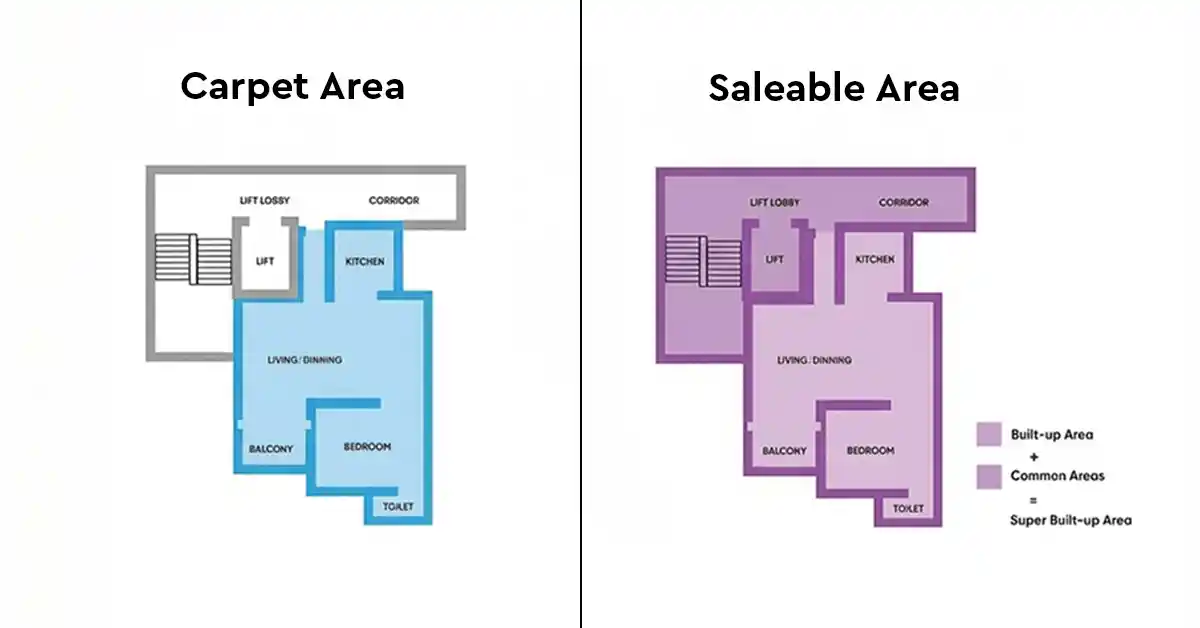
Carpet area means the actual usable floor space within a property’s walls. People can place furniture and perform daily activities in this space. The carpet area excludes common areas, walls, and structural components from the total advertised space. RERA’s definition states it as “the net usable floor area of an apartment, excluding the area covered by external walls, areas under service shafts, exclusive balcony or verandah area”.
Saleable area (also known as super built-up area) includes the carpet area plus a proportionate share of common spaces such as corridors, lobbies, staircases, lifts, and amenities. Buyers pay for this total area, which is typically 25-30% larger than the carpet area.
Developers calculate the difference between these measurements through the loading factor that ranges from 20-40%. A loading factor of 1.4 means the developer added 40% more space to the carpet area.
RERA’s implementation now requires developers to disclose carpet area measurements with transparency. They must price properties based on carpet area instead of built-up or super built-up areas. This change gives homebuyers clarity about their purchase, eliminating previous confusion.
Key Differences Between Carpet Area and Saleable Area
The difference between carpet area and saleable area affects your property investment decisions. Carpet area shows your actual living space, while the saleable area has extra components that make the total area much larger.
Size disparity stands out as the main difference – carpet area makes up only 70-80% of the built-up area. The saleable area is 25-30% bigger than the carpet area, and premium projects can push this difference up to 40-50% more.
Financial impact becomes clear when we look at real costs. A property worth ₹90 lakh with 1,500 sq ft saleable area seems to cost ₹6,000 per sq ft. But with just 1,000 sq ft of carpet area, you end up paying ₹9,000 per sq ft for usable space.
The efficiency ratio helps evaluate property value. The best ratio between carpet area and saleable area ranges from 65-70%. You should carefully evaluate your investment value if ratios fall below 60%.
Legal implications changed after the RERA implementation. Developers must now quote property prices based only on carpet area. No conveyance deed can be registered except on a carpet area basis. This stops misleading pricing practices that confused buyers earlier.
Financial institutions use carpet area to calculate property value and loan eligibility. Municipal bodies determine property taxes based on built-up area instead of saleable measurements.
Smart investors know that the carpet-to-saleable ratio affects investment returns because properties with more usable space generate better rental income.
How to Calculate Carpet Area and Saleable Area
Accurate property measurements help determine your investment’s true value. Simple formulas can help you understand these measurements better, and every homebuyer should know them.
The carpet area calculation requires measuring each room and adding the measurements:
Carpet Area = Sum of all usable areas (bedrooms + living room + kitchen + bathrooms + internal passages) – thickness of inner walls
Here’s a practical example:
- Master Bedroom (12×10 feet): 120 sq ft
- Living Room (15×12 feet): 180 sq ft
- Kitchen (8×6 feet): 48 sq ft
- Bathroom (6×4 feet): 24 sq ft
- Internal Passage: 20 sq ft Total carpet area: 392 sq ft
The saleable area calculation involves two steps:
- Calculate built-up area first: Built-up Area = Carpet Area + Wall Thickness + Balcony Area
- Add proportionate common areas: Saleable Area = Built-up Area + Proportionate Common Area
Your purchase’s efficiency is shown by the loading factor: Loading Factor = (Saleable Area – Carpet Area)/Carpet Area × 100
A 30% loading factor means the builder added 30% to your carpet area. Residential projects typically have loading factors between 25-30%, while premium developments can go up to 50%. Buyers should know that developers must now disclose carpet area measurements clearly and price properties based on carpet area alone, as per RERA guidelines.
Conclusion
The difference between carpet area and saleable area is vital for property investment decisions. This piece shows how these measurements vary a lot, and carpet area usually makes up just 70-80% of what developers market as saleable area.
The financial impact of this gap can hit your wallet hard. Real estate’s true value becomes clear when we look at per-square-foot costs based on usable space instead of saleable area. A flat listed at ₹6,000 per square foot could actually set you back ₹9,000 per square foot of usable carpet area.
Of course, RERA rules have made things more transparent by making developers quote prices based on carpet area, but buyers need to stay alert. Loading factor is a vital aspect to think over – anything over 30% needs a careful look to see if you’re getting your money’s worth.
This knowledge gives you the ability to make better choices. You must check the carpet-to-saleable ratio, understand the loading factor, and work out the actual cost per square foot of living space before signing property papers.
Smart investors dig deeper than advertised numbers. Taking extra time to understand these measurements will help you avoid paying too much and get the home you expect.
